
Blog
When Silence Satisfies the Thief: Clostridium in Your Flock

The Invisible Intruder
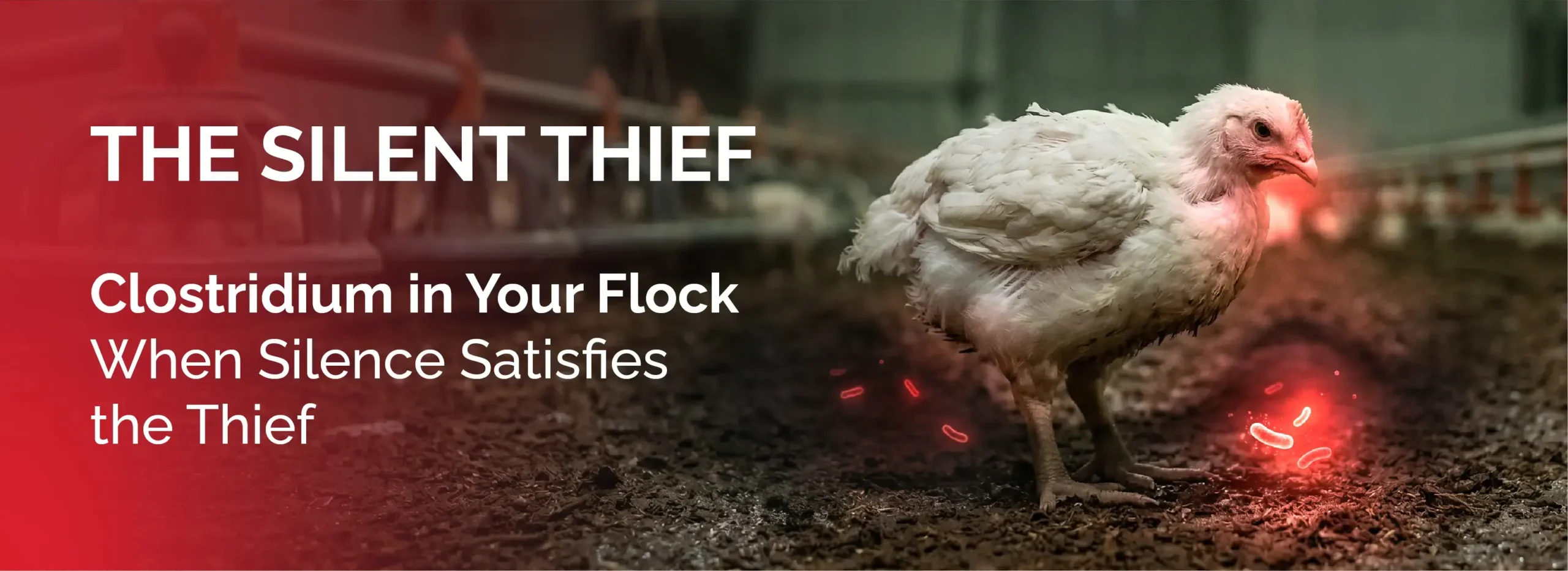
Clostridium perfringens is a Gram positive, anaerobic bacterium whose spores are found virtually everywhere, from soil and dust to the intestinal tract of healthy birds in small, harmless numbers. Under normal conditions, this opportunistic pathogen remains silent, but the moment the environment shifts in its favor, Clostridium: The Silent Thief awakens. Wet litter caused by poor ventilation, leaking nipple lines, or malfunctioning drinkers creates anaerobic pockets beneath the surface where spores activate aggressively. Overcrowded houses, insufficient air exchange, and poor floor insulation further amplify litter moisture, turning the bedding into a breeding ground for Clostridium: The Silent Thief.
The Danger Within and Around
The real danger of Clostridium lies in how effortlessly it exploits every weakness, both inside and outside the bird. Inside the gut, any disruption to the intestinal EU-Biosis can trigger an explosive proliferation; feed transitions from starter to grower or grower to finisher alter protein and energy levels, shifting the microbial balance and giving Clostridium: The Silent Thief the opening it needs. Diets high in animal protein or rich in poorly digestible non starch polysaccharides increase intestinal viscosity, creating the ideal anaerobic microenvironment for bacterial overgrowth. Even minor mucosal injuries caused by coarse feed particles or accidentally ingested foreign bodies trigger mucus accumulation around the wound, forming localized anaerobic zones where Clostridium: The Silent Thief embeds and multiplies. Coccidiosis, particularly infections with Eimeria maxima and Eimeria acervuline, destroys the epithelial lining and generates cellular debris that builds anaerobic layers fueling the spread of Clostridium: The Silent Thief. Prolonged or improper use of broad-spectrum antibiotics disrupts the protective gut flora, removing the competitive barrier that normally keeps the pathogen in check. Outside the bird, high stocking density, inadequate downtime between flocks, and excessive evaporative cooling all contribute to elevated litter moisture, allowing spores to thrive before the birds even make contact. Every stress event, whether environmental, nutritional, or immunological, is an open invitation for Clostridium: The Silent Thief.
What You See on the Farm
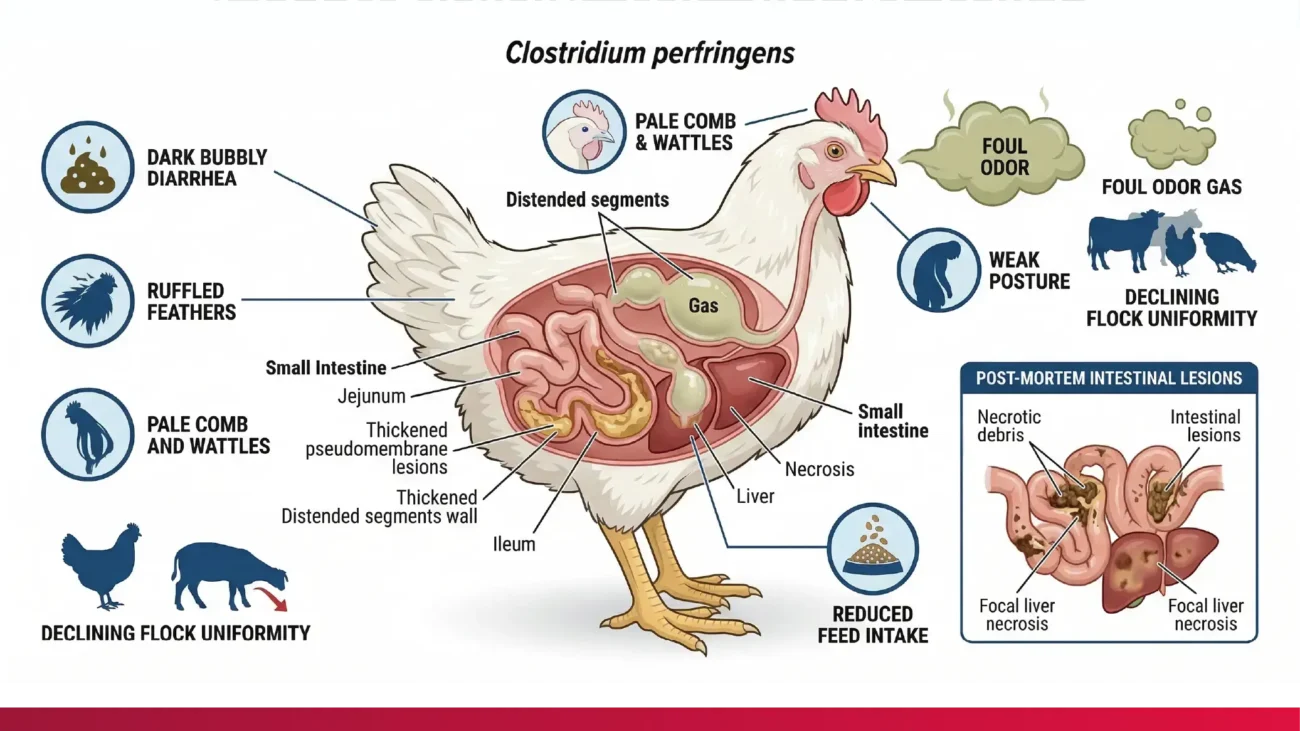
On the farm floor, the signs can range from subtle to alarming. Affected birds often show dark, bubbly diarrhea loaded with gas, general weakness, ruffled feathers, pale combs and wattles, and an obvious reluctance to eat. Flock uniformity drops as Clostridium: The Silent Thief causes some birds to fall behind in growth while others appear unaffected. The distinctive foul odor inside the house intensifies, serving as an early warning that Clostridium: The Silent Thief is active. In acute outbreaks, sudden spikes in mortality can occur with little to no prior warning, catching producers off guard. In many cases, birds simply stop gaining weight despite consuming normal amounts of feed, which is the classic hallmark of Clostridium: The Silent Thief. Post mortem examination reveals a characteristic picture of necrotic enteritis: thickened intestinal walls covered with a yellowish-brown pseudo membrane, alternating with thin, balloon-like distended segments filled with foul smelling gas and necrotic debris. These lesions are most prominent in the jejunum and ileum, and in severe cases the liver may show focal necrosis, confirming the destructive reach of Clostridium: The Silent Thief.
The Economic Blow
The financial impact of this disease extends far beyond mortality figures. While acute clinical outbreaks can push flock mortality to significant levels, the greatest economic damage comes from the subclinical form that persists undetected, and this is precisely what makes Clostridium: The Silent Thief so devastating. Subclinical necrotic enteritis silently erodes performance: birds eat but fail to convert feed into body weight efficiently, leading to a sharp decline in the feed conversion ratio (FCR). Considering that feed cost represents approximately 65% to 75% of total broiler production cost, even a small increase in FCR translates into substantial financial losses at the end of the cycle. Global losses attributed to Clostridium: The Silent Thief induced necrotic enteritis have been estimated at over $6 billion annually, a figure that continues to rise with the growing demand for antibiotic free production. This is not just a disease; it is a profit killer that drains your investment bird by bird, day by day, and that is exactly how Clostridium: The Silent Thief earned its name.
Your Next Move
Prevention is the only winning strategy against Clostridium: The Silent Thief. Ensuring proper house ventilation, replacing wet litter immediately, maintaining strict coccidiosis control programs, optimizing feed quality and digestibility, and incorporating natural gut health solutions during stress periods and feed transitions are all essential pillars of defense. Stay tuned for our upcoming article where we reveal how ADEMIXvet’s LYSOMIX, the ultimate Clostridium crusher, protects your flock and safeguards your profits. Your next read could save your next cycle.